Tips & Data
Cat VI Space-A Travel: Realistic Expectations in 2026
What Cat VI Space-A travel actually looks like in 2026: real selection rates, route restrictions, and what success means as the lowest-priority traveler.
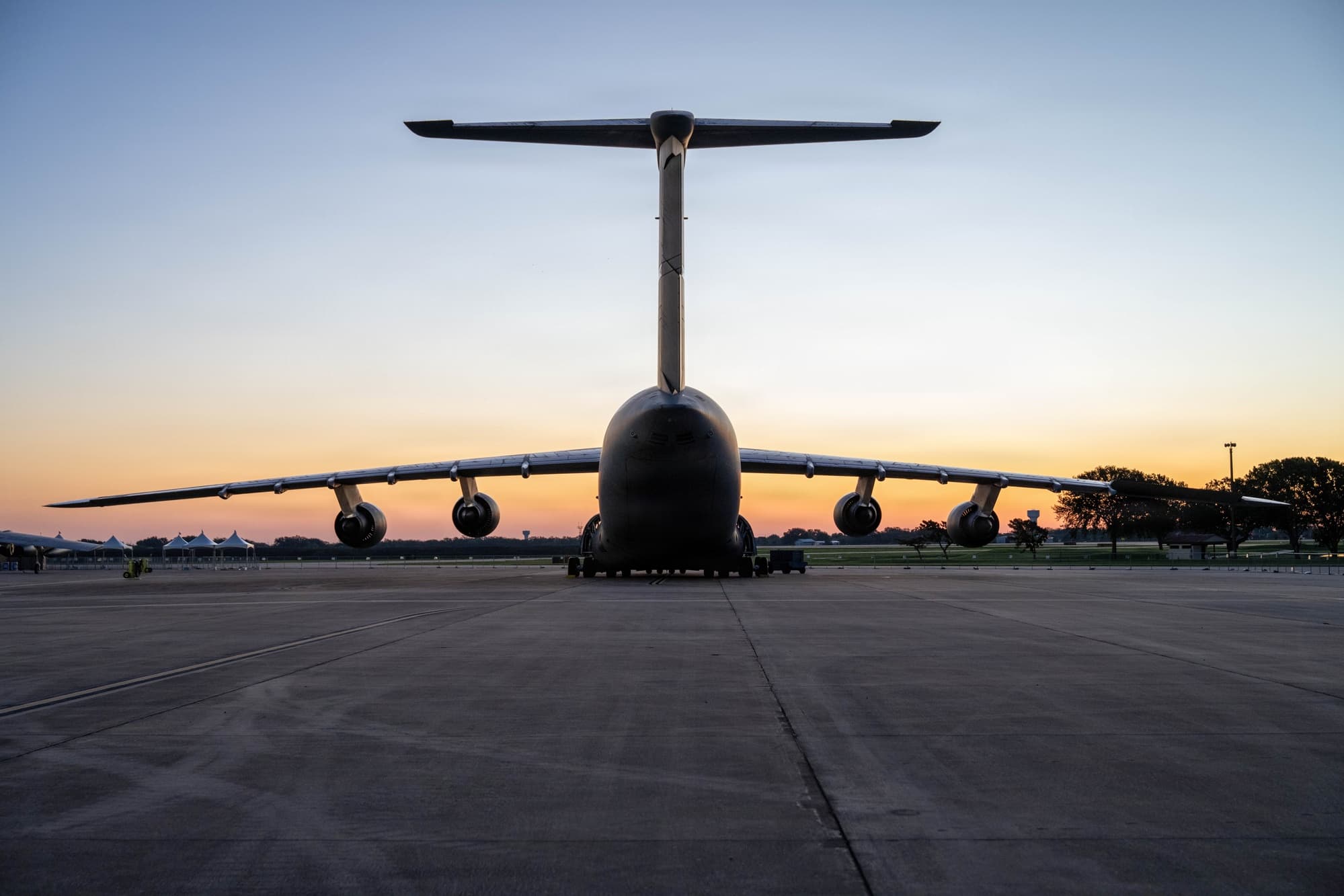
Photo: U.S. Air Force / Airman 1st Class Kevin Jones, 502d Air Base Wing, DVIDS. Public domain.
Cat VI is the lowest of the six Space-A priority categories. If you're a military retiree, a 100% DAV, a gray-area Reserve or Guard retiree, a ROTC / NUPOC / CEC student, or a surviving spouse, this is the category you compete in.
What Cat VI travelers actually need to know is straightforward: what should you realistically expect, which routes work for you, when should you fly, and what does a successful trip look like? This post answers those questions with current data from across the AMC network, not anecdote.
Strategy and tactics live in a separate, future post. This one is about expectations.
Who's in Cat VI, exactly
Cat VI contains five populations, and the travel rules differ:
- Retired uniformed-service members and accompanying dependents (DoDI 4515.13 Table 3 item #37). The largest population. No geographic restrictions; can fly anywhere Space-A goes.
- Reserve/Guard "gray-area retirees" — Reservists and Guardsmen who have earned a retirement (typically 20+ qualifying years) but haven't yet reached age 60 to begin drawing retired pay. Plus accompanying dependents. DoDI 4515.13 Table 3 item #39. Restricted to CONUS, AK, HI, PR, USVI, Guam, American Samoa (Guam and American Samoa travelers may transit Hawaii or Alaska).
- ROTC, NUPOC, and CEC students on authorized absences (DoDI 4515.13 Table 3 items #40–#41). Also restricted to CONUS, AK, HI, and U.S. territories — same geographic envelope as gray-area retirees and 100% DAVs.
- Veterans with a permanent and total (P&T) 100% service-connected disability and accompanying dependents. Table 3 item #47. Restricted to CONUS, AK, HI, PR, USVI, Guam, American Samoa (Guam and American Samoa travelers may transit Hawaii or Alaska).
- Surviving spouses of service members who died on active duty, inactive-duty training, or annual training, or surviving spouses of retired military members, and their accompanying dependents (Table 3 items #48–#51). Cat VI eligibility continues for surviving spouses; they travel under the same rules the sponsor would have used.
Three of these — gray-area retirees, ROTC/NUPOC/CEC students, and 100% P&T DAVs — cannot fly Space-A to Japan, Korea, Europe, Diego Garcia, or any other OCONUS destination outside the named territories. AMC enforces this at the counter. If you fall into any of these three groups, you can still fly Space-A — there are great trips to Hawaii, Alaska, Puerto Rico, and Guam — but your route options look different from a regular retiree's.
Two terms first-timers get wrong
Gray-area retiree. Not the same as "retired but not yet 60." More specifically: a Reserve or Guard member who has completed the qualifying years for a retirement (typically 20 good years) but hasn't yet reached age 60 to begin drawing retired pay. If you have a Notice of Eligibility (NOE) letter from your reserve component but no monthly retired pay yet, you're in the gray area. You're eligible for Space-A, but only to the geographic list above.
100% P&T vs other 100% ratings. "100% disabled" on the VA's books isn't a single status. Only permanent and total (P&T) 100% ratings qualify under Table 3 item #47. A 100% rating flagged for re-examination, surgery, or convalescence — a "100% schedular" rating that isn't yet permanent — does not. Check your VA rating decision letter: if it says "permanent and total" or "no future examinations scheduled," you qualify. If it specifies a future re-examination date, you don't. AMC turns DAVs away at the counter for this regularly.
Cat VI by the numbers
Across the AMC network in the trailing 12 months, Cat VI travelers won the seat on roughly 85% of categorized roll calls. The breakdown:
Which category won the seat · trailing 12 mo
Check eligibility →| Category | Share of flights | Flights |
|---|---|---|
| Cat I | 0.6% | 28 |
| Cat II | 2% | 95 |
| Cat III | 9.2% | 432 |
| Cat IV | 3.5% | 163 |
| Cat V | 6.1% | 285 |
| Cat VI | 78.5% | 3671 |
Based on 4,674 roll calls with a recorded lowest-selected category. Roll call walks Cat I first, Cat VI last.
That widget is live data — pulling from every roll-call result we've ingested in the last year, across every tracked terminal. Cat VI's dominance in cleared seats isn't because Cat VI gets priority (it doesn't — it boards last). It's because on most flights, by the time the roll-call walker reaches Cat VI, there are still seats left. The 87%-of-seats-unclaimed figure that defines Space-A overall isn't despite Cat VI travelers — it's visible because Cat VI travelers absorb the seats higher categories don't fill.
The numbers don't say every Cat VI traveler always gets on. They say the system has plenty of slack at the Cat VI level — if your trip falls inside the windows and routes where the slack actually shows up. The rest of this post is about finding those windows and routes.
Within Cat VI, every minute counts
Cat VI dominance in cleared seats doesn't mean every Cat VI traveler in the room gets on. On busy roll calls, the sign-up timestamp inside Cat VI decides order — per DAFI 24-605V2 § 2.34.1, "PSAs will select passengers by category and date and time of sign-up." A Cat VI traveler who signed up 59 days out boards ahead of a Cat VI traveler who signed up a week ago — every time.
This is the single biggest within-category lever, and it's free. Per DAFI 24-605V2 § 2.29.1 (with § 2.25.4 also referencing Julian date and Zulu time), sign-up times are recorded in Zulu (GMT). Submit the moment your 60-day window opens (DoDI 4515.13 § 4.7.c) — even five minutes of edge can push you ahead of dozens of later sign-ups on a popular route.
What "selection rate" actually means
When travelers say "the success rate is X%," they're usually conflating three different numbers:
- Per-flight pass rate — what percentage of Cat VI travelers in the backlog got a seat on a given roll call. This is the number that swings wildly by route and season.
- Per-trip success rate — what percentage of Cat VI travelers got on some flight to their destination over a 3–7 day attempt window. This is the number you actually care about.
- Per-sign-up rate — what percentage of 60-day sign-up windows result in a successful flight. The most generous framing.
A 30% per-flight pass rate over 5 attempts compounds to roughly an 83% per-trip success rate (the probability of failing all five is 0.7⁵ ≈ 17%). That's why flexibility matters so much — every additional attempt compounds your odds. The widget below shows real route history for the canonical Cat VI route (Travis → Hickam).
Travis AFB, CA → JB Pearl Harbor-Hickam, HI · trailing 12 mo
Plan this route →184
flights
42.9
avg seats released
39.9%
avg fill
Flights per month
Oct
Nov
Dec
Jan
Feb
Mar
Apr
May
Jun
Jul
Aug
Sep
Oct
What good Cat VI selection looks like by season
The system has predictable rhythms. Knowing them is most of the game.
October, late January through February, mid-September. These are the easiest Cat VI windows in the calendar. PCS season is over, the DoDEA breaks are in the rear-view, and the holiday surge hasn't started. Cat VI travelers regularly clear on first or second attempts on the major rotators and most CONUS hops.
Late February through mid-March. Quiet window before DoDEA spring break. Good for Pacific and CONUS trips.
Mid-April through late May. Post-spring-break, pre-PCS. Reliable Cat VI window for Europe and the Pacific.
Late August through mid-September. Post-PCS, pre-DoDEA fall start. Selection rates jump immediately after Labor Day at most terminals.
The windows to avoid. June 1 – August 15 (summer PCS peak), December 15 – January 5 (Christmas / New Year), March 20 – April 10 (DoDEA spring break). Cat VI gets squeezed hard during these windows. Not always shut out, but routinely several times lower than baseline.
The pattern is visible in the data. The calendar below shows daily seat releases at Travis — the canonical Cat VI gateway to Hawaii — for October 2025, one of the easier Cat VI months in the year. Darker cells mean more seats released that day; blank cells mean no flights cleared.
Travis AFB, CA · seats released per day · October 2025
Terminal page →For exact DoDEA break dates by school year and region, see the Beginner's Guide.
What good Cat VI selection looks like by route
Some routes are reliably Cat-VI-friendly across the year; others are reliably brutal. As a general read:
Reliably Cat-VI-friendly routes (multiple attempts per week, decent fill rates):
- Travis ↔ Hickam (West Coast to Hawaii). High volume, frequent cargo missions on top of the rotator.
- BWI ↔ Ramstein (East Coast to Europe). Multiple weekly Patriot Express flights, near-daily during peak summer season.
- Travis / SeaTac ↔ Yokota / Kadena (West Coast to Japan). Multiple weekly flights.
- Dover ↔ Ramstein (East Coast to Europe). Heavy cargo schedule on top of PE. JB Lindsey Graham ↔ Ramstein runs lighter — useful as a backup, not as your primary East-Coast sign-up.
- Hickam ↔ Kwajalein. Intermittent C-12 rotator. Access requires a Form 55-R sponsorship through US Army Kwajalein Atoll — effectively closed to recreational Space-A travelers.
Tougher Cat VI routes:
- Anywhere into Diego Garcia. Limited cadence, often EML-loaded.
- Westbound out of Ramstein in December. CONUS-bound holiday surge from Europe.
- Eastbound out of Hickam in summer and fall. The easy outbound to Hawaii becomes a stuck return — PCS season fills the CONUS-bound rotator, and there's less organic cargo lift eastbound than westbound on this leg. Build extra return-trip buffer for Hawaii trips between May and October.
- Eastbound out of Yokota in summer. PCS season fills the CONUS-bound rotators.
- Single-leg "thin route" destinations (Misawa, Iwakuni, Lajes). Less volume = more variance.
Inadmissible for gray-area and DAV travelers, but admissible for regular retirees: all OCONUS routes outside CONUS / AK / HI / PR / USVI / Guam / American Samoa.
What "success" should look like at Cat VI
Calibrate your plan to the math.
A typical successful Cat VI trip looks like: Sign up 30+ days out at 3–5 terminals. Watch the schedule. Travel during a non-peak window. Show up at one of your sign-up terminals on day 1 of your attempt window. Sometimes you clear on attempt one; sometimes Cat VI doesn't roll back to you and you try the next morning. Most Cat VI travelers in non-peak windows clear within 1–3 attempts. Spend 4 days in destination. Watch the return schedule. Get on a return flight within your buffer window. Total elapsed: 6–10 days, $50–150 in head taxes and food at the terminal.
A typical bad Cat VI trip looks like: Sign up 7 days out at one terminal. Travel during DoDEA spring break. Show up day 1, don't get on. Don't have backup flights. Pay $1,200 for a commercial ticket out. Repeat in reverse for the return. Total elapsed: 5–7 days, $2,400 spent.
The difference isn't luck. It's four planning decisions made before the trip starts.
The four planning decisions that determine the trip
- Window length. Anything under 5 days is a gamble. 7–10 days is the sweet spot for high-success-rate trips. 14+ days gives you the most margin — but no Space-A trip is ever guaranteed; the most flexible window in the calendar can still get stranded by a real-world tasking shift or a string of weather divert days.
- Date selection. Avoid the avoid-windows. The October sweet spot has several times the selection rate of the Christmas window for identical Cat VI travelers on identical routes.
- Terminal count. One terminal is a single shot. Three terminals is three independent shots. Five terminals at major hubs covers most of the AMC network for transatlantic or transpacific routes.
- Buffer commitment. A 3-day buffer on the return is the minimum. 7 days is comfortable. Zero buffer means you'll pay for a commercial ticket about half the time.
Recent roll-call clearances at Travis — the canonical Cat-VI-to-Hawaii gateway — show what realistic Cat VI movement looks like in practice:
Recent roll calls — Travis AFB, CA
Terminal page →| Date | To | Released | Used | Lowest Cat |
|---|---|---|---|---|
| 2026-10-16 | Joint Base Andrews, MD | 19 | 3 | VI |
| 2026-10-16 | NAS North Island (NASNI) Coronado, CA | 19 | 0 | — |
| 2026-10-16 | JB Pearl Harbor-Hickam, HI · Osan AB, ROK · Yokota AB, Japan | 73 | 19 | VI |
| 2026-10-14 | JB Elmendorf-Richardson, AK · Yokota AB, Japan | 69 | 8 | VI |
| 2026-10-13 | JB Elmendorf-Richardson, AK · Yokota AB, Japan | 69 | 4 | VI |
| 2026-10-12 | JB Pearl Harbor-Hickam, HI · Andersen AFB, Guam | 0 | 0 | — |
| 2026-10-11 | Yokota AB, Japan · Osan AB, ROK | 3 | 1 | VI |
| 2026-10-11 | JB Pearl Harbor-Hickam, HI · Andersen AFB, Guam · JB Elmendorf-Richardson, AK | 0 | 0 | — |
| 2026-10-10 | JB Pearl Harbor-Hickam, HI | 73 | 10 | VI |
| 2026-10-10 | JB Pearl Harbor-Hickam, HI · Yokota AB, Japan | 73 | 18 | VI |
What "failure" should look like at Cat VI
Some trips don't work even with perfect planning. The genuinely-bad outcomes look like:
- Diverted on the way home with no Space-A onward. Per DAFI 24-605V2 § 2.77.4.1 (which applies to contract commercial / Patriot Express flights), if the diversion stop has no onward Space-A, the carrier owes you onward movement; if it does, those costs are on you. For organic-aircraft diversions (C-17, C-5, etc.), § 2.77.2 has different rules — you're typically responsible for your own meals and billets and ride the same aircraft when it resumes its mission. Plan a $500–1,000 credit buffer either way.
- Stuck on the outbound and can't reach destination in your window. This is what your buffer days are for. Eat the cost of one or two terminal nights and you're fine; don't book downstream commitments inside your buffer window.
- Aircraft cancelled and the terminal puts everyone on the next flight that doesn't materialize. It happens. Have a Plan B commercial ticket pre-priced on your phone.
If you've made the four planning decisions right and still don't get on, the trip is salvageable. If you've made none of them, the trip is what teaches you to make them right next time.
How to know when to switch terminals mid-trip
A common Cat VI mistake: showing up at one terminal on day 1, not getting on, and waiting in that terminal another 3 days for the same flight. If the next viable flight is from a different terminal that's a 4-hour drive away, drive. Your sign-up at that terminal is already active (you signed up at all five, right?). You're not starting over.
The Browse Flights board shows every flight from every tracked terminal in one view, with seat counts as they're released — the easiest way to make the "stay or drive" call without phoning around.
What changed for Cat VI between 2024 and 2026
Most of the 2025–2026 program changes affect Cat VI the same as any other category — see the overview in How Space-A Actually Works in 2026. One change is worth re-emphasizing here for Cat VI specifically: DAFI 24-605V2 (30 January 2025) documented the Zulu sign-up timestamp standard. For Cat VI — where sign-up order inside the category decides everything — this matters more than it does for higher categories that aren't competing on timestamp as often. Submit at the start of your 60-day window, not the convenient hour.
The five things to do right now if you're Cat VI
- Confirm your specific Cat VI sub-category. Gray-area retirees and 100% DAVs face the geographic restriction; everyone else doesn't. The Eligibility Wizard walks the distinction in two minutes.
- Pick a 7–10 day window outside the peak months. October, late January through February, and mid-September are your friends.
- Sign up at 3–5 terminals. Plan a Trip handles the multi-terminal submission automatically once you set the route.
- Pre-price a commercial backup. Know what a one-way ticket costs on the routes you're trying. If you've been stuck 3 days and cadence has dried up, the backup is the right call.
- Read the system before showing up. This post and the Beginner's Guide cover the rules; the Browse Flights board shows you the cadence on your specific route.
Questions we hear
FAQ
What's the real Cat VI success rate?
There isn't one number — it depends entirely on route and season. On easy CONUS-to-Hawaii routes in October, Cat VI selection per attempt is high. On Ramstein westbound during Christmas week, it's low. The per-trip success rate over a 7-day attempt window with multi-terminal sign-up is much higher than the per-flight pass rate suggests. Network-wide over the last 12 months, Cat VI was the winning category on roughly 85% of categorized roll calls.
Can a 100% DAV fly Space-A to Japan?
No. Per DoDI 4515.13 Table 3 item #47, 100% DAVs are restricted to CONUS, Alaska, Hawaii, Puerto Rico, USVI, Guam, and American Samoa. AMC turns travelers away at the counter for this. Regular military retirees with no DAV restriction can fly to Japan.
Can a gray-area Reserve retiree fly Space-A to Europe?
No. Per Table 3 item #39, Reserve and Guard gray-area retirees are restricted to the same geographic list as 100% DAVs. They can fly between CONUS and Hawaii or Alaska or Guam, but not to Ramstein, Aviano, RAF Mildenhall, or any other European destination.
How many terminals should I sign up at?
Three at minimum, five for major trips. The Plan a Trip feature submits to all the relevant terminals automatically — once you set the route, the platform identifies them and submits sign-ups in parallel.
Do I have to travel during a peak window if my time off is fixed?
You can try, but expect lower selection rates and bring a real commercial backup. Cat VI travelers who succeed during peaks typically succeed because they had a 10+ day window and got on attempts 4 or 5, not the first one.
What's the most common mistake Cat VI travelers make?
Signing up at only one terminal. Single-terminal sign-up turns a manageable 3-attempt problem into a 1-attempt gamble. The fix is free and takes 10 minutes per terminal.
Can I check my golf clubs or other oversized items?
Yes, within the standard Space-A baggage allowance (DoDI 4515.13 § 4.2.a, cross-referenced in DAFI 24-605V2 § 2.108 — 2 pieces, 70 lb each, plus a carry-on and personal item). Golf clubs count as one piece. If the bag exceeds 70 lb you'll need to redistribute weight at the counter. Firearms are allowed under federal aviation rules but must be declared, locked in a hard case, and ammunition stored separately — bring the documentation. Check your destination's import rules before flying overseas.
If I take a Space-A flight, does my 60-day sign-up reset?
No. Your sign-up at a terminal stays active for the full 60-day window (DoDI 4515.13 § 4.7.c) regardless of how many flights you take from it. The window only resets when you re-submit a new sign-up. Many Cat VI travelers don't realize this and re-sign-up unnecessarily after every trip.
Plan a Cat VI trip the right way
Find out if you can fly Space-A.
Two-minute wizard walks you through Cat I–VI, dependents, and the documents you'll need at sign-up. Built off DoDI 4515.13 Change 7.
Check eligibility →Related reading
Patriot Express vs. True Space-A: What's the Difference in 2026
AMC's Patriot Express commercial rotators and cargo Space-A missions share a sign-up but almost nothing else. The operational comparison — schedule, fees, pets, baggage, delays, boarding priority.
Tips & Data

5 Things First-Time Space-A Travelers Get Wrong (And How to Fix Them)
Five fixable mistakes most first-time Space-A travelers make — and the playbook for avoiding each one before your first flight.
Tips & Data

Best Space-A Routes for Cat VI Travelers in 2026
A route-map for every Cat VI population — regular retirees, gray-area Reserve and Guard, 100% disabled veterans, and surviving spouses — with the best Hawaii, Alaska, Europe, and Pacific routes for 2026.
Tips & Data